AI, Skills, Learning design, Readiness
Are You a Knowledge Worker or a Value Worker?
AI can make early output look like capability. The Value Continuum distinguishes surface productivity from the judgment and adaptability that hold up when work changes.

Mike Vaughan, September 26, 2026
10 min read
A Knowledge Worker creates value by applying what they know. A Value Worker creates value when what they know is no longer enough.
For most of a career, the two look identical from the outside. AI is what makes the difference visible, and expensive.
The Value Continuum
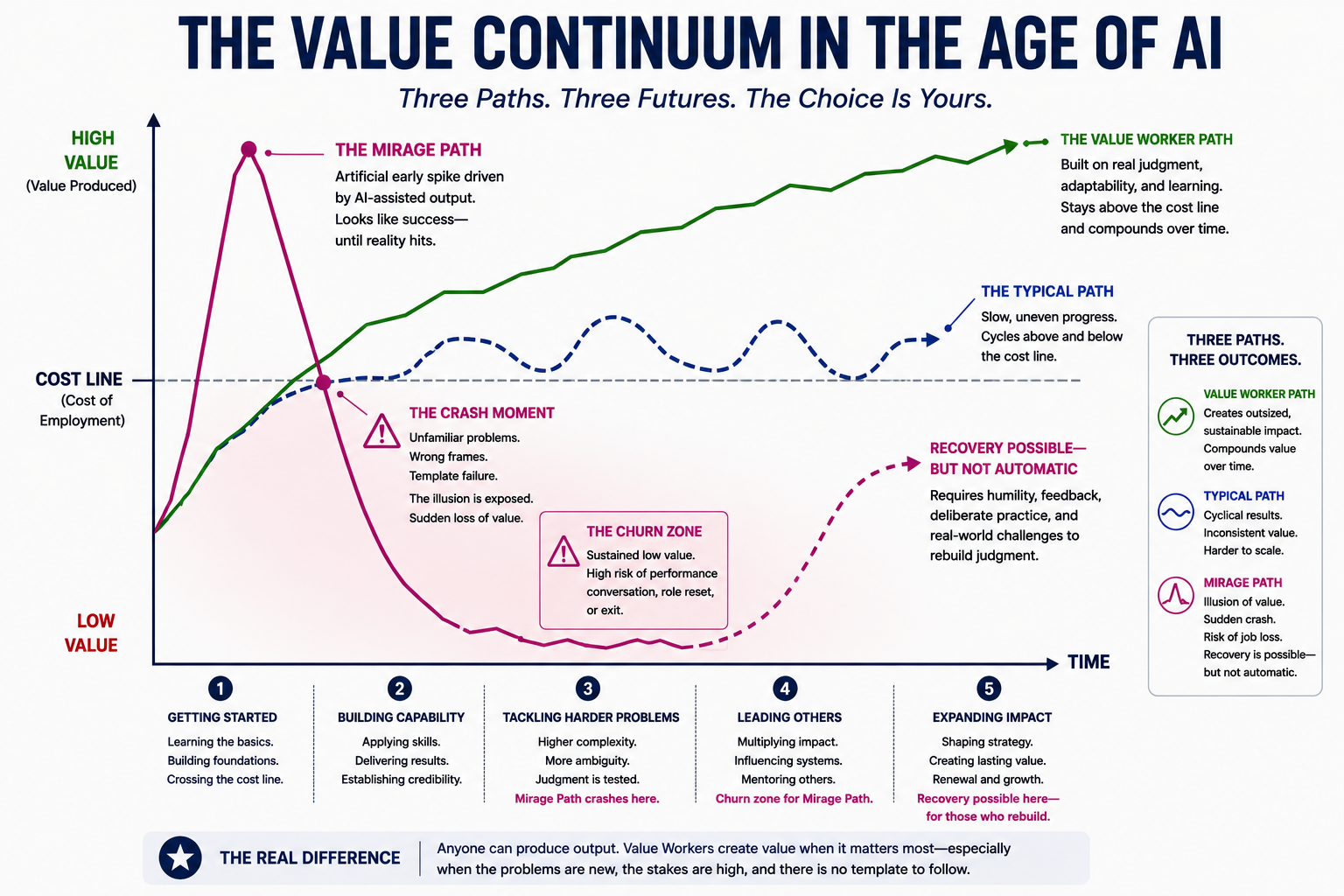
Where do you fit on the continuum? The Value Continuum model tracks the relationship between the value a person produces and the cost of employing them, over time. It is not meant to reduce anyone to a financial equation. It is meant to show whether a contribution is growing with the complexity of the work.
A cost line runs across the graph. Above it, someone creates more value than they cost. Below it, the organization is still investing more than it is receiving.
Most careers follow the typical path: a gradual climb, then a cycle above and below the cost line. The upward swings come from a new role, a new company, or a fresh burst of motivation. The downward dips come when the market or the organization shifts and demands a way of thinking the person has not developed yet. The situation changed. The person did not.
Value Workers follow a different path. It rises faster, crosses the cost line earlier, and stays above it, not because they avoid difficulty, but because they learn, unlearn, and adapt faster than the situation changes.
Three milestones mark that path:
- Time to Value: how long it takes a person's value to exceed their cost. People with stronger thinking habits cross this threshold faster.
- Value Potential: what a person is capable of producing as new situations arise. This determines whether someone keeps growing or stalls as the work gets harder.
- Value Spanning: the value a person creates beyond their own role, once their thinking starts to influence other people and the wider organization.
In practice, this shows up as five recognizable career stages: getting started, building capability, tackling harder problems, leading others, and expanding impact. The important point is that the third stage, tackling harder problems, is where the illusion usually breaks. Early output can look impressive, but complexity exposes whether judgment has actually been built.
The Value Worker
After years of observing performance across more than one hundred high-stakes corporate simulations, one pattern was hard to ignore: senior titles, quick answers, and confident talk were poor predictors of who actually created value when the situation changed. Tenure alone did not explain it either. What separated the best performers was a specific kind of experience: enough encounters with being wrong that they had built the habit of pausing, asking the question no one else was asking, and adapting when their first answer stopped working. That habit, earned rather than assumed, is exactly what lets someone question an answer instead of accepting it, whether it came from a colleague, their own instinct, or an AI model.
That earned-experience idea is apprenticeship, described without the label. The traditional model was exactly that: put a less experienced person next to a more experienced one, let them watch real judgment get exercised on real problems, and correct them in the moment they get it wrong. Nobody develops the habit of pausing before trusting an answer by being told to. It gets earned by being watched, corrected, and pushed past a first answer that didn't hold up, enough times that pausing becomes automatic.
Hybrid work has already made that harder, by reducing proximity between junior people and the senior people they used to learn from. AI is making it harder again, by compressing or removing the very tasks junior people used to learn through. The fix is not to preserve slow work for its own sake. It is to identify which parts of the struggle actually build judgment, and protect those on purpose.
A strong guide still matters here. AI can create practice opportunities and cut administrative load, but it cannot replace the lived judgment of someone who has actually done the work.
When that guide is missing, or the struggle gets automated away before it can do its work, a specific pitfall opens up.
The Mirage Path
There's a simpler way to describe what happens when that struggle disappears: Value Workers operate in what psychologist Marilee Adams called Learner mode, and what we think of as Explorer mode. They're mapping territory they haven't seen yet, scanning for what they don't know, willing to change their mind when new information shows up. The alternative is Confirmer mode: defending ground already staked out, looking for whatever confirms the answer you already believe. AI makes Confirmer mode dangerously easy, because it will hand you a plausible-sounding answer before you've had to defend anything.
AI has introduced a third path, and it is the hardest one to recognize while you are on it. We call it the Mirage Path. It is Confirmer mode at scale.
Unlike the typical path, it does not climb slowly toward the cost line. Unlike the Value Worker path, it does not rise because judgment is developing ahead of the work. It spikes almost vertically because AI-assisted output can look like value long before the judgment behind it has formed. The report is clean, the recommendation is clear, and from the outside it looks like someone crossed the Time to Value threshold months ahead of schedule.
The Mirage Path is a career built above the waterline. AI produces what everyone can see: the deck, the summary, the confident recommendation. What remains hidden is the work below the surface: framing, tested assumptions, judgment, and the ability to defend the answer when challenged.
For a while, that may be enough. In familiar situations, where the problem is well framed and a template applies, the mirage looks almost identical to real growth. The difference shows up the moment the work stops matching the pattern. Call it the Crash Moment.
An unfamiliar client problem arrives. The data has no clean comparable. The AI-generated recommendation rests on an assumption no one examined. The client asks, "Why did you assume this market behaves like our existing one?" and the room goes quiet.
The Mirage Path does not dip gradually here. It does not end with a gentle performance conversation. It ends in exposure, in front of the client, because the person is suddenly asked to supply judgment the earlier work never required them to build.
That is when the Mirage Path collapses. Not because AI failed, but because the human development underneath the work never happened.
Surface Time to Value vs. Real Time to Value
This matters most early in a career. AI can dramatically reduce the time it takes to produce acceptable work. It does not automatically reduce the time it takes to develop judgment, and it can lengthen that process by removing the struggle that used to build it.
A junior analyst can now produce in an afternoon what used to take a team a week. The output may be useful. The manager sees saved time. The organization may be losing the moment where judgment would have formed.
Did the analyst learn to frame the problem, challenge the data, or recognize when the client was asking the wrong question? Maybe. But if the AI simply helped her produce the answer faster, she may have missed the exact struggle that would have taught her how to think.
Surface Time to Value is how quickly someone can produce work that looks useful. Real Time to Value is how quickly someone can make sound judgments in unfamiliar situations. AI accelerates the first. It cannot, by itself, create the second.
What follows a crash, if nothing changes, is what the model calls the Churn Zone: a sustained stretch of low value that carries real risk of a performance conversation, role reset, or exit.
Recovery has to start immediately, not eventually. It is an intentional pivot, not a destination further down the timeline. It means stepping back to rebuild the exact muscles the mirage let someone avoid using: framing the problem, forming a point of view, defending reasoning, and learning from consequences. Wait too long and the rebuilding only gets harder, not because the person is incapable, but because outsourcing the struggle becomes its own kind of cognitive rust.
If recovery starts quickly, the person can rebuild. If it is delayed, the organization usually stops waiting. None of this is solved by wishing for a slower world. It gets solved by building the missing repetitions back in, deliberately, and at a scale one guide's calendar could never provide.
Why This Has to Be Practiced, Not Taught
None of this develops by reading about it. Because AI removes the natural cognitive struggle of everyday work, organizations can no longer rely on passive, on-the-job exposure to build judgment. If people learn exclusively inside live client work, the first real sign of a gap is an expensive, public one.
That is why deliberate practice matters, and why simulation becomes so useful. A well-designed simulation creates enough pressure, ambiguity, and consequence to reveal how someone actually thinks, and lets a hidden default fail safely, in a sandbox, before it fails in front of a client.
It is the flight simulator for judgment: not a substitute for the real thing, but a place to exercise judgment before the stakes are real, and a place that can run as many reps as a person needs, not just as many as a guide has hours in a week to give.
What a Value Worker Practices
Inside a well-designed simulation, the reps are not random. They are built around five practices, the same ones a good guide would eventually drill into an apprentice over years, just compressed into far more reps than any real caseload could generate.
Question the Frame
Left alone, AI is a compliance machine. It optimizes for the prompt it is given, even when that prompt rests on the wrong assumption. It will answer with confidence before anyone has asked whether the question deserves an answer at all. A Value Worker does not just refine the prompt. Sometimes they reject it and ask what problem is actually being solved.
Read the Pattern
AI accelerates the surface. It can tell you what just happened, but not why an underlying feedback loop keeps producing it. A Value Worker looks past the isolated alert for the recurring structure underneath, and resists the temptation to treat a systemic problem as a series of unrelated events.
Find the Leverage
AI makes it easy to scale the wrong solution brilliantly fast. A Value Worker pulls the emergency brake on the machine to ask whether the action changes the underlying condition or simply automates the symptom. They refuse to confuse motion with progress.
Surface the Assumption
AI-generated work arrives in polished, confident language, which can trick the brain into assuming objectivity. Researchers Raja Parasuraman and Dietrich Manzey call this automation bias: a well-documented tendency to trust an automated system's output and do less independent checking, not more, once it looks plausible. It shows up in experts as often as novices, and it gets worse under time pressure. Value Workers treat that confidence as a signal to slow down and audit what is missing, not a reason to move faster.
Machine Orchestration
Value Workers treat AI like an extremely fast, highly capable, slightly unreliable new hire: useful and tireless, but still in need of direction, review, and judgment. They frame the work before AI begins, decide what kind of help is needed, and audit what comes back. They orchestrate the machine's role before it gets defined by default.
What makes this worth doing inside a simulation, rather than just describing it in a memo, is that these five practices only become real once they've been applied under pressure, to something that feels like it matters. Enough of those reps, and a person develops the same judgment a Value Worker used to earn only through twenty years of real encounters with being wrong, compressed into a fraction of the time. That is what lets an organization trust someone to sign off on an audit, a legal filing, or a client recommendation with real confidence, not because they have decades of tenure, but because they have already been tested against situations realistic enough to teach them what tenure used to teach.
Same Curve, Same Discipline
Whether someone is building Time to Value for the first time or extending Value Potential years into a career, the discipline is the same: better questions, clearer assumptions, stronger feedback, deliberate practice, and the willingness to test their thinking against reality.
The question is not whether AI will make people more productive. It already does. The question is whether that productivity is helping someone climb the Value Continuum or letting them ride the mirage. The two can look identical for a while. Both produce polished work. Both create speed. The difference appears when the situation changes, the data is incomplete, or the recommendation carries real consequences. That has a practical implication worth stating directly. A title was never a reliable signal of who could create value when the situation changed, and AI is about to make that gap harder to hide, not easier. What gets coveted next isn't the title on someone's card. It's whether they can think clearly with AI in the room, question what it hands back, and help the people around them do the same. Don't chase the next title. Chase the next rep.
Three paths. Three futures. That is when every professional has to ask: am I becoming more valuable, or merely producing more work that looks valuable?
Concepts in this piece
- The Value Worker
How learning and adaptation contribute to useful work as responsibilities change.
Working through a decision or a learning design? Talk with Mike.